
✨ This article was AI edited. Editorial responsibility: WindPowerFacts.info.
Produced with AI. This article was artificially generated. Editorial responsibility: WindPowerFacts.info.
What are the environmental impacts of geothermal energy? Geothermal energy is among the lowest-carbon power sources available, generating lifecycle emissions of only 15 to 45 gCO&sub2eq/kWh while maintaining the smallest physical land footprint (approx. 400 m² per GWh) of any utility-scale power technology. Its primary environmental considerations include managing non-condensable gases (such as hydrogen sulfide in flash plants), preventing groundwater contamination via deep brine reinjection, and controlling induced micro-seismicity in Enhanced Geothermal Systems (EGS).
As governments worldwide accelerate renewable energy targets, geothermal power is prized for a capability that solar and wind lack: providing 24/7/365 baseload, dispatchable clean electricity completely independent of weather conditions. However, tapping into subterranean thermal reservoirs situated thousands of feet beneath the Earth’s crust involves complex thermodynamic, geochemical, and geological interactions. Evaluating the comprehensive environmental balance sheet of geothermal energy requires examining its air emissions, hydrological cycles, surface land efficiency, and seismic dynamics.
Atmospheric Emissions: Binary Cycle vs. Flash Steam Facilities
The atmospheric profile of a geothermal plant depends heavily on the thermodynamic plant design utilized:
| Geothermal Technology Type | Operating Cycle Mechanism | Air Emissions Profile | Environmental Assessment |
|---|---|---|---|
| Closed-Loop Binary Cycle | Geothermal fluid never touches the atmosphere; heats a secondary working fluid (isobutane) in a closed heat exchanger | Near-Zero (<5 gCO&sub2eq/kWh); zero particulate matter, SO&sub2, or NOx | Gold standard of clean power; essentially zero air quality impact |
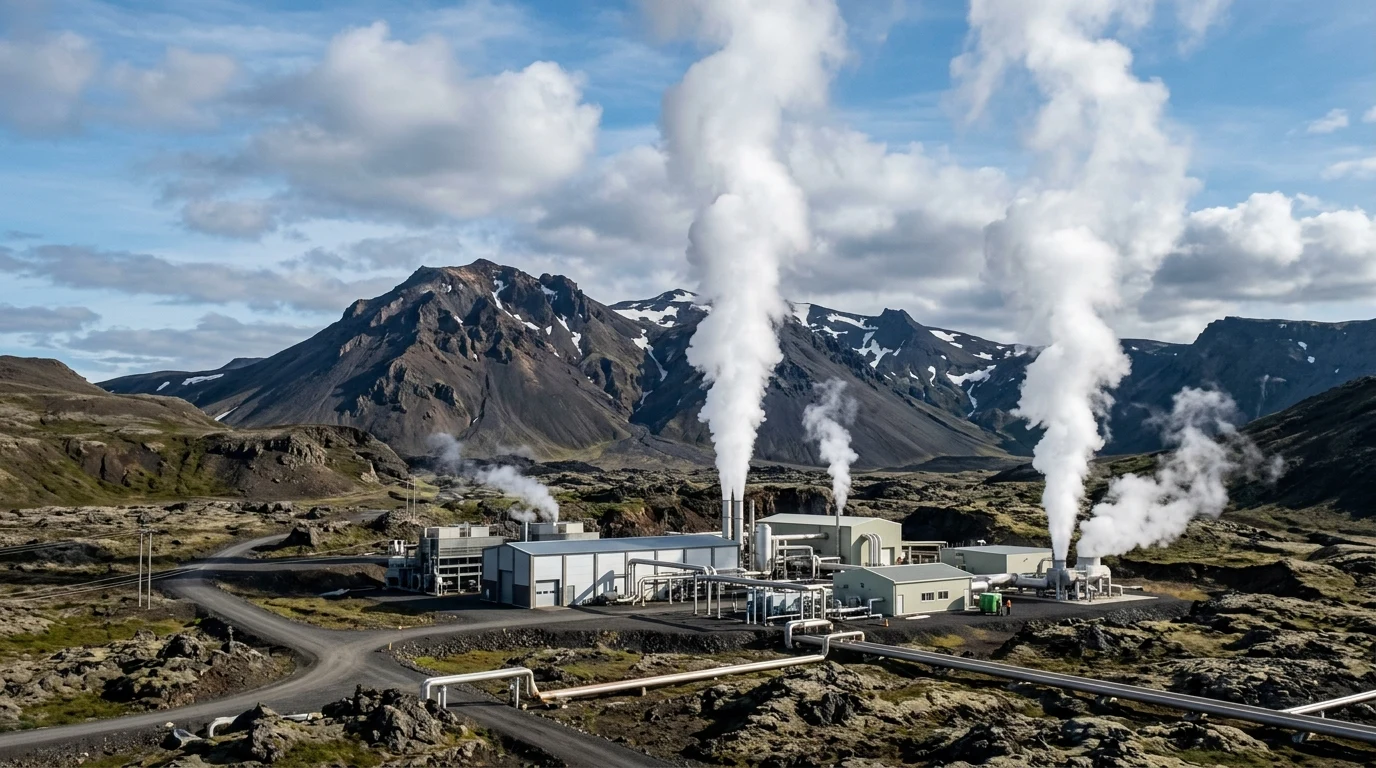
| Flash Steam Plant | High-pressure deep geothermal brine is flashed into steam; non-condensable gases vented through cooling towers | Low (approx. 30–60 gCO&sub2eq/kWh); trace hydrogen sulfide (H&sub2S) | Emits 95% less CO&sub2 than natural gas; H&sub2S scrubbers remove 99.9% of sulfur odor |
| Dry Steam Plant | Pulls natural subsurface steam directly to drive a turbine (e.g., The Geysers, CA) | Low (approx. 40–80 gCO&sub2eq/kWh); trace methane and ammonia | Minor local odor potential without active abatement systems |
Unlike coal, oil, or natural gas generating stations, geothermal power plants do not burn any fuel. There is zero combustion. Trace carbon dioxide and hydrogen sulfide released from flash facilities originate naturally from dissolved volcanic gases trapped within the subterranean aquifer.
Hydrological Impacts: Water Use and Brine Reinjection
The interaction between geothermal energy and local groundwater resources is governed by strict environmental engineering controls:
1. Deep Closed-Loop Reinjection
Deep geothermal fluids (brines) are highly saline and rich in dissolved silica, boron, arsenic, and heavy metals. In modern regulatory regimes, 100% of cooled geothermal brine is pumped directly back into the deep reservoir through dedicated injection wells located 3,000 to 10,000 feet below the surface. Multiple layers of steel casing cemented into surrounding bedrock isolate the injection pipe, completely preventing heavy metals from contacting shallow drinking water aquifers.
2. Operational Water Consumption
Binary cycle power plants utilizing air-cooled condensers (dry cooling) consume zero freshwater during operation. Water-cooled flash steam plants consume approximately 1,500 to 2,500 liters of water per megawatt-hour (similar to nuclear power), but modern facilities condense the flashed steam itself to serve as cooling tower makeup water, avoiding the depletion of municipal surface water supplies.
Land Footprint: How Geothermal Compares to Solar, Wind, and Coal
One of the greatest environmental strengths of geothermal infrastructure is its minimal spatial land requirement. Because the primary resource is stacked vertically beneath the ground, the surface footprint is exceptionally compact:
| Energy Source | Surface Land Footprint (m² per GWh over 30 yrs) | Visual and Habitat Impact | Land Co-Use Compatibility |
|---|---|---|---|
| Geothermal Energy | ≈ 400 m² | Minimal; clustered industrial buildings and wellheads | High; surrounding land remains usable for agriculture/grazing |
| Nuclear Energy | ≈ 1,000 m² | Compact industrial facility + security buffer zone | Moderate; strict access boundaries |
| Utility-Scale Solar PV | ≈ 3,200 m² | Extensive surface coverage; fence-to-fence land clearing | Low; agrivoltaics emerging but limited in utility farms |
| Onshore Wind Energy | ≈ 1,300 m² (direct footprint) | Tall kinetic towers visible over broad horizon | Exceptional; 98% of wind farm land remains active farmland |
| Coal (Mining + Plant) | ≈ 3,600 m² | Massive strip mining, mountaintop removal, ash lagoons | Zero; long-term ecological devastation |
Induced Seismicity: Understanding Seismic Risk in Enhanced Geothermal Systems (EGS)
The most widely debated physical risk associated with modern geothermal expansion is induced seismicity (human-triggered earthquakes):
- Conventional Hydrothermal Systems: Tapping into naturally permeable aquifers rarely produces noticeable earthquakes. Fluid pressures remain balanced through paired production and reinjection wells.
- Enhanced Geothermal Systems (EGS): When attempting to harvest geothermal heat from impermeable “hot dry rock,” engineers inject high-pressure water to create micro-fractures in deep crystalline granite. This hydraulic stimulation can trigger slip along pre-existing subterranean fault lines.
- Historical Cautionary Tales: In 2006, an EGS project in Basel, Switzerland, was permanently canceled after hydraulic stimulation triggered a magnitude 3.4 earthquake that caused structural plaster cracking. In 2017, a deep EGS project in Pohang, South Korea, triggered a damaging magnitude 5.5 earthquake due to unmapped fault proximity.
- Modern Mitigation Protocols: Today, geothermal developers utilize Traffic Light Systems (TLS) coupled with dense micro-seismic geophone sensor arrays. If micro-tremors exceed magnitude 1.0 or 2.0, injection pressures are instantaneously bled off, preventing the buildup of stress required to generate noticeable surface quakes. Advanced closed-loop conductive systems (which circulate fluid through sealed borehole loops without hydraulic fracturing) eliminate induced seismicity risks entirely.
The Mineral Co-Product Revolution: Green Lithium Extraction
Far from merely avoiding environmental harm, modern geothermal operations are pioneering a major positive ecological breakthrough: direct lithium extraction (DLE). Geothermal brines in regions like California’s Salton Sea and the Upper Rhine Valley in Germany contain high concentrations of dissolved battery-grade lithium.
Extracting lithium directly from geothermal brine before reinjecting the fluid eliminates the need for environmentally destructive open-pit hard-rock mines or massive evaporation ponds in water-scarce desert salt flats. A single geothermal plant can simultaneously generate baseload clean power and sustainably harvest enough domestic green lithium to manufacture hundreds of thousands of electric vehicle batteries annually.
Frequently Asked Questions
Does geothermal energy cause greenhouse gas emissions?
Closed-loop binary cycle geothermal plants produce near-zero operational emissions. Flash steam plants release small amounts of naturally occurring dissolved CO&sub2 (approx. 30 to 60 gCO&sub2/kWh), which is less than 5% of the emissions produced by an equivalent coal-fired power plant.
Can geothermal power plants run out of heat?
If water is extracted from a geothermal reservoir faster than natural subterranean heat flows replenish it, reservoir temperatures can drop. However, with modern reservoir management and balanced reinjection, geothermal fields (such as Larderello in Italy, which has operated continuously since 1913) remain productive for over a century.
Does geothermal energy smell like rotten eggs?
Only older flash steam plants without proper emissions controls emit the rotten egg smell of hydrogen sulfide (H&sub2S). Modern facilities utilize advanced catalytic scrubbers or closed-loop binary cycles that prevent H&sub2S from escaping into the surrounding community air.
Is geothermal energy safe for local drinking water?
Yes. Production and injection wells are sealed with multiple concentric layers of heavy-gauge steel casing cemented into the surrounding rock down to several thousand feet, creating an impermeable barrier between mineralized geothermal brine and shallow freshwater aquifers.
Get our latest guides, news, and insights highlighted in your Google Search & AI Overviews.