

✨ This article was AI edited. Editorial responsibility: WindPowerFacts.info.
Produced with AI. This article was artificially generated. Editorial responsibility: WindPowerFacts.info.
The safe wind speed for a 12m Spiderbeam is 50 to 60 miles per hour (80 to 95 km/h) under standard two-tier synthetic guying. Survival thresholds can reach up to 75 mph (120 km/h) when the fiberglass telescoping mast is stabilized with four-way multi-level Kevlar guy lines, heavy-duty earth screw anchors, and reduced mast extension during gale conditions.
For amateur radio operators, DXpedition teams, and emergency communication specialists, the full-size Spiderbeam wire yagi mounted on a 12-meter (40-foot) heavy-duty fiberglass telescoping mast represents the pinnacle of portable HF gain. However, deploying a multi-band directional wire antenna with large aerodynamic surface area at an elevation of 12 meters introduces substantial mechanical stresses under turbulent wind loading. Understanding exact aerodynamic limits and structural stabilization protocols is essential to prevent mast buckling and catastrophic antenna destruction.
Aerodynamic Wind Loading: Surface Area of Spiderbeam Arrays
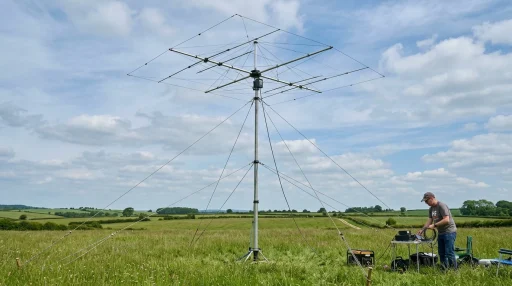
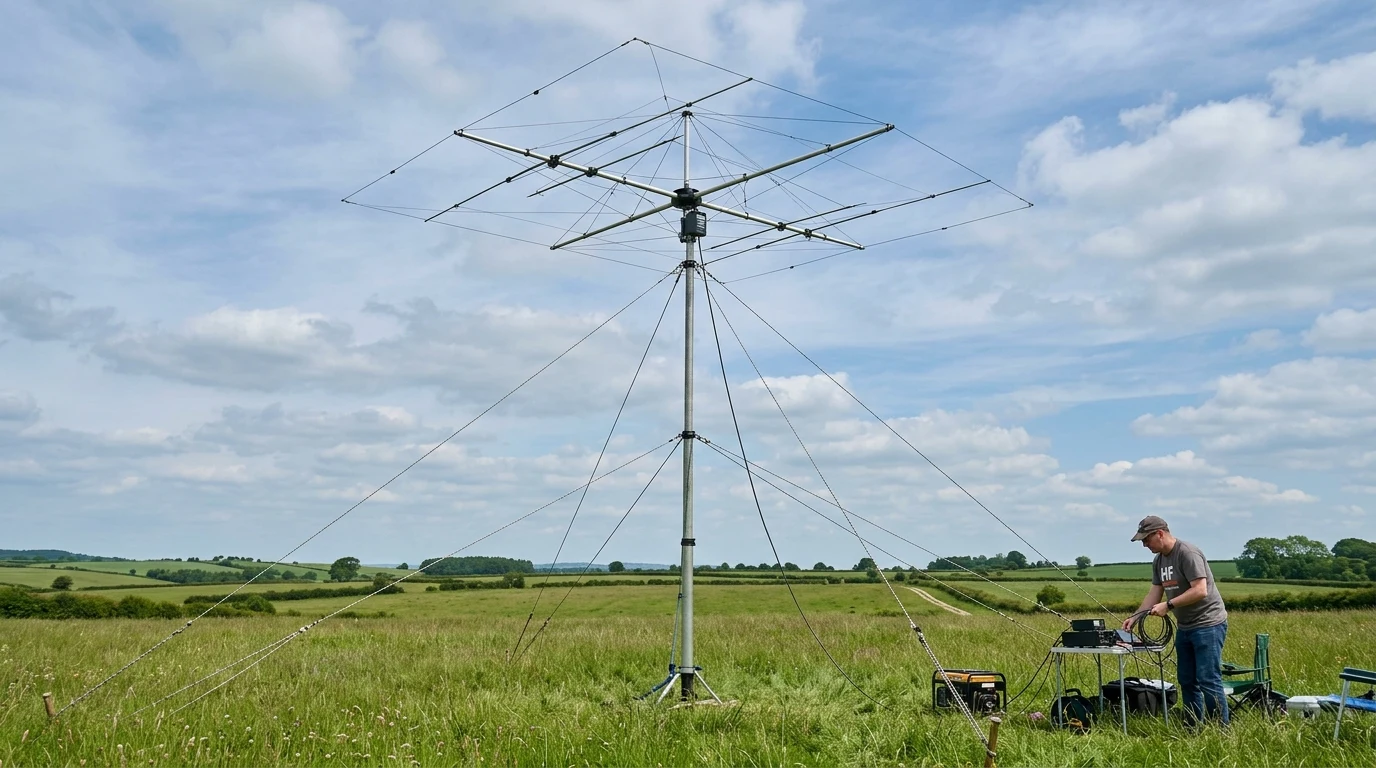
The Spiderbeam directional antenna is engineered from lightweight fiberglass spreader arms and copper wire elements arranged in a spider-like framework. Despite its light mechanical weight (typically 7 to 11 kg depending on 3-band vs 5-band configuration), its effective wind surface area generates substantial aerodynamic drag:
- Effective Wind Surface Area (A): A standard 5-band Spiderbeam (20/17/15/12/10 meters) presents an effective wind surface area of approximately 0.35 to 0.40 square meters (3.8 to 4.3 sq ft).
- Wind Drag Force ($F_w$): Aerodynamic force increases exponentially with velocity according to the formula:
$$F_w = \frac{1}{2} \cdot \rho \cdot v^2 \cdot C_d \cdot A$$
Where $\rho$ is air density (1.225 kg/m³ at sea level), $v$ is wind velocity in meters per second, and $C_d$ is the drag coefficient of circular wire conductors and tubular spreaders (approximately 1.0 to 1.2). - Lateral Turning Torque: At a wind speed of 60 mph (26.8 m/s), a 5-band Spiderbeam generates roughly 210 Newtons (47 lbf) of lateral thrust at the top mast clamp, creating a bending moment of over 2,500 Newton-meters at the mast base without intermediate guying.
Structural Physics of 12m Fiberglass Telescoping Masts
The standard 12-meter heavy-duty fiberglass telescoping mast manufactured for Spiderbeam antennas features reinforced tubular sections tapering from 73 mm outside diameter at the base to 30 mm at the top section, with typical wall thicknesses between 2.0 mm and 3.5 mm.
Fiberglass composite offers superior electrical isolation and flexibility compared to aluminum alloys. Unlike aluminum tubing, which suffers plastic deformation and permanent bending when pushed past yield stress, high-grade fiberglass composite flexes elastically. However, excessive bending creates severe internal delamination and can lead to sudden longitudinal splitting under buckling loads.
Euler Critical Column Buckling
When wind pushes laterally against the antenna head, guy lines convert lateral aerodynamic drag into substantial downward vertical compression along the mast axis. If guy lines are tensioned at steep angles (closer than 45 degrees to the mast), compressive downward force increases dramatically. If downward compression exceeds the critical Euler column load, the mast will bow outward violently and snap at intermediate section overlap joints.
Guying Topologies: 2-Tier vs 4-Tier Guying Systems
No 12-meter telescoping fiberglass pole can survive free-standing in winds above 15 mph. Mechanical survivability is entirely determined by guying geometry, material selection, and anchor integrity.
| Guying Configuration | Guy Attachment Levels | Safe Operating Wind Speed | Survival Gust Limit | Recommended Application |
|---|---|---|---|---|
| Single-Tier Guying | Top collar (10–11m) only | Up to 30 mph (48 km/h) | 40 mph (64 km/h) | Temporary calm-weather field day; high risk of mid-mast buckling |
| Standard 2-Tier Guying | Lower tier (6m) + Upper tier (11m) | Up to 50 mph (80 km/h) | 60 mph (96 km/h) | Standard expedition deployment; balanced stability and rapid setup |
| Heavy-Duty 3-Tier Guying | 4m, 8m, and 11.5m collars | Up to 60 mph (96 km/h) | 70 mph (112 km/h) | Semi-permanent base stations; exposed hilltops and coastal setups |
| Storm-Hardened 4-Tier Guying | 3m, 6m, 9m, and 11.8m collars | Up to 70 mph (112 km/h) | 75–80 mph (120–128 km/h) | Extreme maritime/mountain DXpeditions; maximum deflection resistance |
Guy Line Material Science: Kevlar vs Dyneema vs Polyester
Choosing the correct guy line material is critical for high-wind stability. In a 12-meter mast setup, guy lines must satisfy three non-negotiable engineering criteria:
- Zero RF Interaction: Metallic steel guy wires resonant near HF frequencies disrupt radiation patterns and detune Spiderbeam elements. Non-conductive synthetic materials must be used exclusively.
- Minimal Creep and Elasticity: High elasticity allows the mast to oscillate and gain momentum during alternating wind gusts, inducing destructive resonance. Standard nylon rope stretches up to 15–20% under load and is completely unsuitable.
- UV and Weather Degradation Resistance: Exposure to solar radiation and rain weakens inferior synthetic cords within weeks.
The industry benchmark for Spiderbeam guying is Dacron (Polyester) Pre-Stretched Cord (3 mm or 4 mm) or Aramid/Kevlar-Core Guy Line with a protective polyester jacket. Kevlar-core lines feature less than 1% stretch under working tension, locking the mast rigidly into vertical alignment even as wind velocity spikes.
Ground Anchoring Mechanics in Saturated and Sandy Soils
A guying system is only as reliable as its ground anchors. High winds exert combined shear and upward pullout forces on guy anchors. At a 45-degree guy angle, every pound of lateral wind drag creates an equal upward vertical pull on the windward ground stake.
- Spiral Earth Screw Anchors: For grass, loam, or clay terrain, 40 cm to 60 cm heavy-duty spiral steel screw anchors provide superior holding power (exceeding 300 kg pullout resistance per anchor).
- Driven Angle Stakes: In rocky or hard-packed terrain where earth screws cannot penetrate, 50 cm steel angle-iron stakes driven into the earth at a 45-degree angle pointing away from the mast provide reliable shear resistance.
- Sand and Snow Anchors: In loose coastal dunes or snowy mountain passes, standard stakes pull out easily. Operators must employ “deadman” anchors—burying wide boards, flat stones, or heavy sandbags at least 0.75 meters underground.
Emergency High-Wind Storm Procedures
When atmospheric weather forecasts predict sustained gale-force winds exceeding 60 mph or convective storm fronts with violent microbursts, operators should enact preventive measures before severe weather arrives:
- Telescope Down: Lower the top two or three sections of the fiberglass mast. Reducing mast height from 12 meters to 7 or 8 meters cuts overturning torque by more than 40% while preserving mechanical integrity.
- Align Antenna Boom Parallel to Prevailing Wind: Rotate the directional Spiderbeam so that the main center boom faces directly into the oncoming wind vector. This presents the minimal cross-sectional drag profile compared to broadside wind exposure.
- Inspect Guy Clamps and Tensioners: Verify that stainless steel mast clamps are torqued securely with protective rubber padding, and ensure guy line tensioners have not slipped.
Frequently Asked Questions
Can a 12m Spiderbeam mast survive 70 mph winds?
A 12m Spiderbeam mast can survive gusts up to 70 mph only if rigged with a heavy-duty 4-tier guying configuration using non-stretch Kevlar or pre-stretched Dacron guy lines anchored at wide 45-degree angles. If using a basic 2-tier setup, sustained winds above 55 mph risk buckling the intermediate mast joints.
What is the ideal guy anchor distance from a 12m mast base?
The ideal anchor distance is between 6 and 8 meters (20 to 26 feet) from the mast base. Placing guy anchors at roughly 60% to 75% of mast height ensures guy lines meet the mast at a 45-degree to 55-degree angle, optimizing lateral stabilization while minimizing destructive downward axial compression.
Can I use steel wire ropes for guying a Spiderbeam?
No. Steel wire ropes should never be used to guy an HF wire antenna because metallic guy lines interact electrostatically and magnetically with antenna elements. Steel wires will detune the SWR, create parasitic resonance, distort the directional radiation pattern, and degrade front-to-back rejection ratios.
Get our latest guides, news, and insights highlighted in your Google Search & AI Overviews.


