
✨ This article was AI edited. Editorial responsibility: WindPowerFacts.info.
Produced with AI. This article was artificially generated. Editorial responsibility: WindPowerFacts.info.
Are trees strong? Yes, trees are among nature’s most resilient biomechanical structures, engineered to endure hundreds of tons of dynamic wind force over centuries. Their strength stems from a composite cellular matrix of cellulose fibers and lignin, adaptive growth (thigmomorphogenesis), flexible reaction wood, and widespread underground root anchor plates that distribute mechanical load into the earth.
When standing beneath a towering oak or watching a pine sway in a fierce storm, it is natural to wonder about the physical limits of these living organisms. Trees are not rigid, unyielding columns; rather, they are sophisticated biological structures optimized through millions of years of evolution to absorb, dampen, and redirect mechanical energy. Understanding how trees achieve their strength reveals remarkable parallels between natural biomechanics and modern structural engineering.
The Cellular Engineering of Wood: Nature’s Ultimate Composite
At the microscopic level, wood is a fiber-reinforced composite material comparable to carbon fiber or reinforced concrete. The remarkable tensile and compressive strength of trees is derived from two primary biochemical polymers:
- Cellulose Microfibrils (Tensile Strength): Long chains of glucose molecules aligned parallel to the length of wood cells provide extraordinary tensile strength. Cellulose enables tree trunks and branches to stretch and bend without snapping under immense wind drag.
- Lignin Matrix (Compressive Strength): Lignin is a rigid organic polymer that impregnates the spaces between cellulose microfibrils. It acts as the “resin” or “concrete” in the composite, preventing wood cells from buckling under compressive loads caused by gravity and windward bending moments.
- Microfibril Angle (MFA): The angle at which cellulose fibers wind around the cell wall dynamically determines flexibility versus stiffness. Trees adjust this angle in response to environmental conditions, creating spring-like flexible wood in juveniles and rigid structural wood in mature specimens.
Thigmomorphogenesis: How Wind Makes Trees Stronger
Trees are not passive victims of wind; they actively respond to mechanical stress through a biological phenomenon known as thigmomorphogenesis. When wind bends a tree trunk, mechanoreceptors in living cambial cells trigger hormonal cascades (primarily ethylene and auxin) that modify growth patterns:
- Radial Thickening over Height: Wind-exposed trees allocate metabolic resources toward widening the trunk base (buttressing) rather than growing taller, effectively reducing the lever-arm length against wind.
- Optimized Trunk Taper: Trees naturally develop a uniform stress taper along their stem, ensuring that bending moments are distributed evenly from the crown to the root plate rather than concentrating at a single weak point.
- Reaction Wood Synthesis: In response to directional wind pressures or slope gradients, trees synthesize specialized “reaction wood”:
- Compression Wood (Conifers): Gymnosperms produce dense, heavily lignified wood on the lower (leeward) side of leaning stems to physically push the trunk upright.
- Tension Wood (Hardwoods): Angiosperms generate gelatinous, cellulose-rich wood fibers on the upper (windward) side to pull the trunk upright under high tension.
Biomechanical Strength Metrics: Species Comparison Table
Material engineers and arborists evaluate tree structural strength using three standardized mechanical properties: Modulus of Rupture (MOR), measuring bending strength; Modulus of Elasticity (MOE), measuring stiffness and flexibility; and Janka Hardness, measuring surface indentation resistance:
| Tree Species | Botanical Name | Modulus of Rupture (MOR in MPa) | Modulus of Elasticity (MOE in GPa) | Janka Hardness (lbf) | Wind Survival Strategy |
|---|---|---|---|---|---|
| Shagbark Hickory | Carya ovata | 139 MPa | 14.9 GPa | 1,880 lbf | Extreme rigidity; massive tensile fiber strength |
| Live Oak | Quercus virginiana | 119 MPa | 13.7 GPa | 2,680 lbf | Dense intertwined grain; massive lateral branch spread |
| White Oak | Quercus alba | 105 MPa | 12.3 GPa | 1,360 lbf | Deep taproot anchoring; high flexural resistance |
| Sugar Maple | Acer saccharum | 109 MPa | 12.6 GPa | 1,450 lbf | Balanced structural density; strong branch attachments |
| Douglas Fir | Pseudotsuga menziesii | 85 MPa | 13.4 GPa | 710 lbf | Elastic canopy damping; streamlined needle shedding |
| Bald Cypress | Taxodium distichum | 73 MPa | 9.9 GPa | 510 lbf | Flexible stem damping; buttressed knees anchor in mud |
| Eastern White Pine | Pinus strobus | 59 MPa | 8.5 GPa | 380 lbf | Sacrificial branch shedding to preserve main trunk |
| Silver Maple | Acer saccharinum | 61 MPa | 7.9 GPa | 700 lbf | Fast growth; brittle fibers prone to storm failure |
The Root Plate: Underground Anchor Mechanics
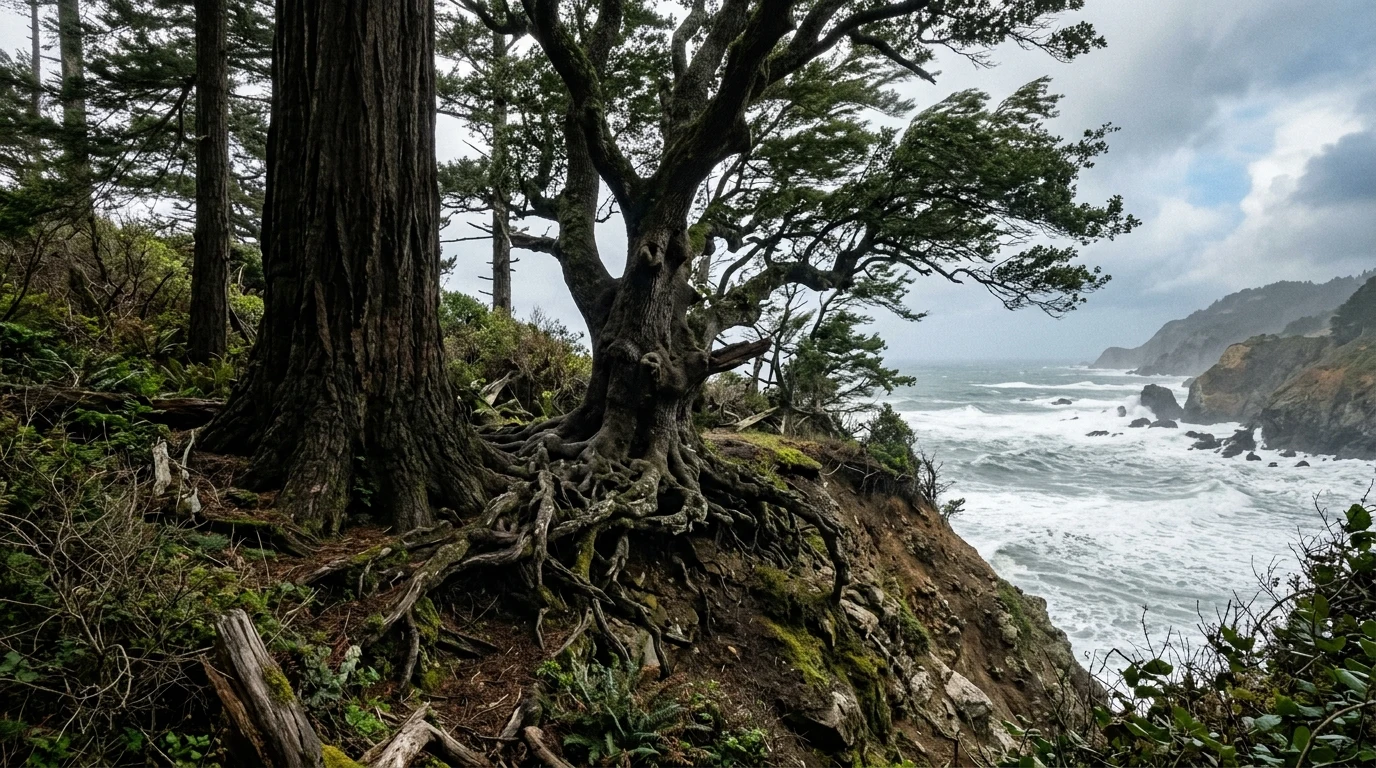
Even the strongest wood trunk is useless without robust anchorage in the soil. Contrary to the popular myth that trees have taproots mirroring their canopy height, the vast majority of a tree’s root system resides in the top 18 to 36 inches of soil, spreading outwards up to two to three times the radius of the canopy.
Tree anchorage functions as a complex mechanical hinge known as the root-soil plate:
- Windward Anchor Roots: When wind pushes the tree from the left, roots on the left side are placed under intense tensile stress, pulling against the surrounding soil matrix like guy-wires on a radio tower.
- Leeward Hinge Zone: Roots on the right side are driven downward into the earth under massive compressive loads, acting as a fulcrum pivot that resists sinking into the subsoil.
- Sinker and Taproots: Vertical roots branching off lateral root beams lock into denser subsoil layers, preventing horizontal slippage and rotational overturn.
- Mycorrhizal Fungal Fusing: Billions of fungal hyphae bind microscopic soil particles to root surfaces, multiplying the effective surface area and cohesion of the root plate tenfold.
Remarkable Natural Adaptations in Extreme Environments
Trees exhibit specialized adaptations that enable survival in environments where continuous wind and gravity would defeat man-made structures:
1. Dynamic Canopy Streamlining (Aeroelastic Reconfiguration)
During wind gusts, trees do not stand rigid; their leaves roll up, branches fold inward toward the center of the stem, and the crown naturally reorganizes into an aerodynamic teardrop shape. This dynamic reconfiguration can reduce the tree’s drag coefficient (C_d) by up to 50% as wind speed escalates from 20 mph to 60 mph.
2. Damping Oscillation and Energy Dissipation
When wind gusts strike, individual branches oscillate at different natural frequencies. Because the branches vibrate out of sync with one another, their mechanical kinetic energies cancel out through destructive interference. This prevents the trunk from reaching dangerous resonant harmonic frequencies that could tear the tree apart.
3. Krummholz Stunting in Alpine and Coastal Zones
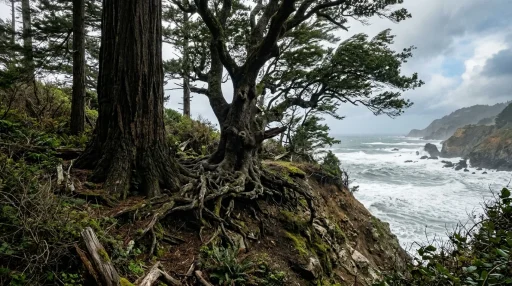
At high altitudes and along exposed oceanic coasts, persistent gale-force winds suppress apical leader buds, forcing trees such as coastal junipers and subalpine firs into dense, prostrate, ground-hugging mats known as krummholz. These trees remain structurally unbreakable because they eliminate the lever-arm entirely.
Frequently Asked Questions
How much force can a mature tree withstand before breaking?
A healthy, mature hardwood tree (such as an oak or hickory) with a 24-inch trunk diameter can withstand bending moments exceeding 150,000 to 250,000 foot-pounds of torque. This corresponds to dynamic wind gusts of 70 to 80 mph before structural fiber failure occurs.
Why do trees bend in the wind instead of standing rigid?
Flexibility is a tree’s primary defense mechanism against wind. By flexing, the canopy streamlines to reduce aerodynamic drag, while the elastic bending absorbs and dissipates kinetic energy into the wood fibers and root plate without reaching catastrophic fracture limits.
Which tree species has the strongest wood?
Among North American native trees, Shagbark Hickory (Carya ovata) and Live Oak (Quercus virginiana) possess the highest structural strength, with Moduli of Rupture exceeding 119 to 139 MPa and exceptional resistance to storm blowdowns.
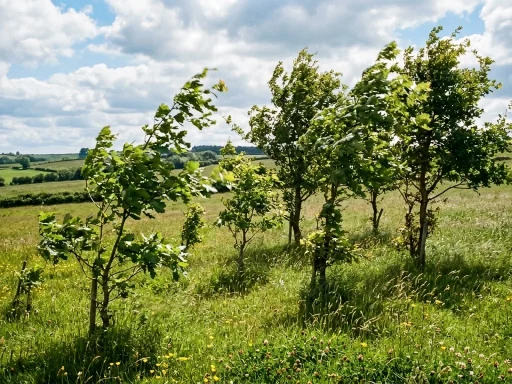
Do staked young trees grow stronger than unstaked trees?
No. Staking trees rigidly actually weakens them over time. Without experiencing natural wind movement, young trees do not produce ethylene to stimulate trunk thickening, resulting in thin, weak trunks that snap easily once stakes are removed. Proper staking should allow slight natural movement.
Get our latest guides, news, and insights highlighted in your Google Search & AI Overviews.