

✨ This article was AI edited. Editorial responsibility: WindPowerFacts.info.
Produced with AI. This article was artificially generated. Editorial responsibility: WindPowerFacts.info.
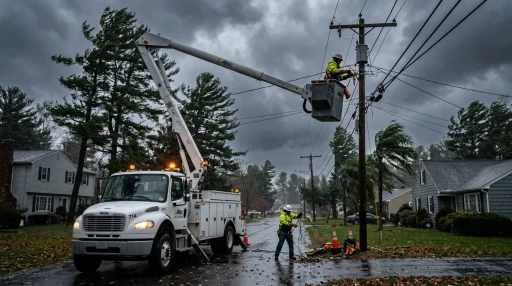
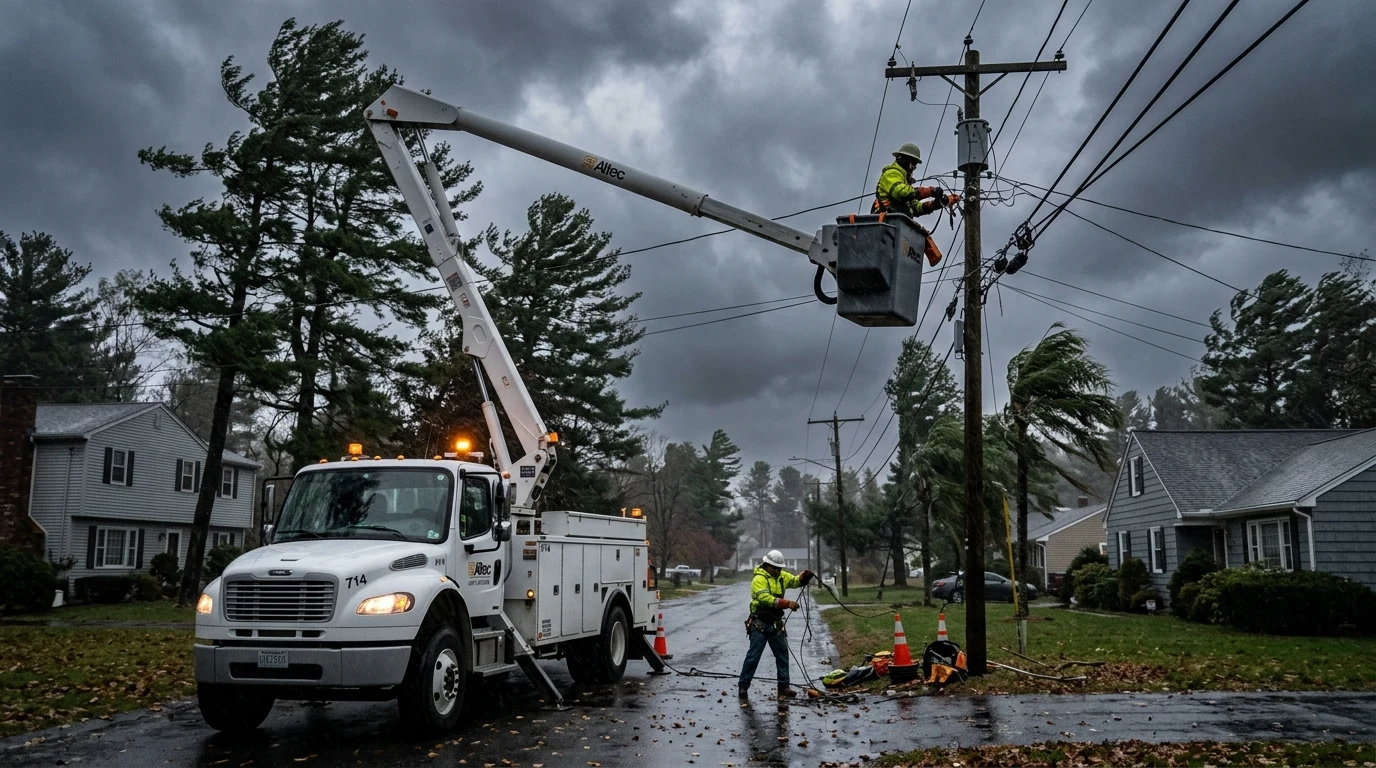
High winds complicate power restoration by imposing strict structural and safety limitations on utility operations. Elevated aerial boom trucks cannot safely operate in sustained winds exceeding 30 to 35 miles per hour, airborne debris continuously inflicts secondary circuit faults, and galloping conductors create lethal arc flash hazards that force emergency electrical repair crews to stand down until peak atmospheric turbulence subsides.
When severe storms, nor’easters, or convective weather systems tear through regional power corridors, public pressure for rapid grid re-energization escalates rapidly. However, electrical distribution restoration is governed by immutable aerodynamic principles and occupational safety thresholds. Electric utilities cannot simply deploy line crews into gale-force environments without risking catastrophic equipment failure and fatal electrocution events.
The Physics of Aerial Elevation: OSHA 1910.269 and Bucket Truck Wind Caps
The primary operational barrier preventing rapid line restoration during windy conditions is mechanical stability in aerial work platforms. Utility distribution systems rely on vehicle-mounted elevating and rotating aerial devices—commonly known as bucket trucks—governed by OSHA Standard 29 CFR 1910.269 and ANSI/SAIA A92.2 specifications.
Under these engineering standards, insulated aerial booms are engineered to withstand maximum rated platform capacities under static conditions. However, when an extended fiberglass boom reaches 40 to 60 feet into the atmospheric boundary layer, dynamic wind loading introduces severe harmonic oscillations:
- Aerodynamic Sail Area: The bucket, combined with the line worker’s torso, cold-weather personal protective equipment (PPE), and rubber insulating goods, presents substantial surface drag that induces lateral boom deflection.
- Hydraulic Drift and Tipping Moments: Sustained wind pressures exceeding 30 miles per hour (48 km/h), with localized gusts over 40 miles per hour, create overturning moments that can overpower stabilizing hydraulic outriggers, especially on saturated roadside soils.
- Dielectric Air Gap Compromise: Gusting winds alter the minimum approach distance (MAD) required between uninsulated live conductors and bucket personnel, creating arc-flash hazards through unintended boom sway.
Consequently, utility dispatch supervisors enforce mandatory “booms down” safety stand-downs whenever wind velocity crosses the 30–35 mph threshold. Line workers remain staged inside insulated cabs, monitoring anemometer readings and preparing repair assemblies while waiting for sustained speeds to drop below dangerous operating levels.
Conductor Aerodynamics: Galloping Lines and Wire Slap Phenomena
High winds do not merely delay the arrival of physical repair personnel; they actively create secondary electrical faults across previously undamaged circuits. High-voltage transmission circuits and medium-voltage distribution three-phase lines are susceptible to dynamic wind-induced phenomena that trigger immediate substation circuit breaker lockouts.
Galloping Conductors: When wind flows perpendicularly across overhead wires coated with asymmetrical rime ice or salt spray, aerodynamic lift forces mimic the behavior of an aircraft wing. The overhead spans oscillate vertically in violent standing waves with amplitudes exceeding 10 to 15 feet. These oscillations cause conductors of different electrical phases to make intermittent physical contact, generating explosive line-to-line faults that burn through aluminum conductor steel-reinforced (ACSR) cables.
Phase-to-Phase Wire Slap: Even without ice accumulation, turbulent gusts exceeding 50 mph cause adjacent phases to swing asynchronously. When the mechanical tension across spanning poles is uneven, wind gusts force conductors into contact, melting protective insulation, tripping electronic reclosers, and frequently snapping crossarms under sudden tension imbalances.
Restoration Bottlenecks: Tree Clearing and Vegetation Zone Hazards
In heavily forested rights-of-way, overhead distribution wires are intertwined with municipal tree canopies. High winds convert dead, diseased, or brittle tree limbs into unguided ballistic hazards. Electric utilities report that over 70% of storm-related outages originate from vegetation falling onto overhead wires.
Restoration requires a sequential, two-phase response before electrical repairs can commence:
- Certified Tree Trimmer Dispatch: Standard line mechanics cannot string conductors until specialized high-voltage arborists remove fallen limbs and unstable “hazard trees” caught in tensioned neutral wires.
- Environmental Hazard Clearance: Wind gusts continue to dislodge hanging branches (often termed “widow-makers”) suspended directly above the right-of-way. Safety protocols prohibit ground crews from operating chainsaws or clearing brush directly beneath swaying overhead tree canopies until winds drop below gale force.
The Standard Utility Restoration Hierarchy
Once atmospheric conditions stabilize and wind velocities permit safe deployment, electric utilities execute a systematic restoration algorithm designed to return power to the greatest number of critical customers in the shortest logistical timeframe.
| Priority Tier | Infrastructure Component | Typical Voltage Level | Direct Restoration Impact |
|---|---|---|---|
| Tier 1 | High-Voltage Transmission Lines & Towers | 69 kV – 500 kV | Energizes regional substations and downstream distribution networks |
| Tier 2 | Substation Transformers & Switchgear | 12 kV – 34.5 kV | Restores power routing capability to critical hospital and emergency services |
| Tier 3 | Three-Phase Main Distribution Feeders | 4 kV – 13.8 kV | Restores 1,000 to 5,000 commercial and residential customers per feeder |
| Tier 4 | Single-Phase Lateral Branches & Fuses | 2.4 kV – 7.2 kV | Restores residential streets, cul-de-sacs, and neighborhood clusters (50–200 homes) |
| Tier 5 | Individual Service Drops & Transformers | 120 V / 240 V | Restores single residences or small commercial meters |
When wind damage impacts Tier 1 and Tier 2 assets simultaneously, utility operations must focus all skilled labor on primary transmission corridors. Neighborhood-level outages remain completely unaddressed until the core transmission backbone is verified stable and re-energized.
Comparative Analysis: Wind Speeds vs Utility Crew Operational Capabilities
| Wind Velocity (MPH) | Beaufort Classification | Grid Infrastructure Hazard Profile | Crew Operational Status |
|---|---|---|---|
| 0 – 20 mph | Light to Moderate Breeze | Negligible structural stress; minor leaf blowoff | Full operational capability; routine aerial and underground maintenance |
| 21 – 30 mph | Fresh to Strong Breeze | Small tree branches sway; overhead conductors experience minor lateral drift | Standard aerial bucket operations permitted with heightened wind monitoring |
| 31 – 39 mph | Near Gale | Large tree branches in motion; loose siding displaced; telephone wires whistle | Booms Stand-Down Enacted: Bucket elevation halted; ground switching only |
| 40 – 54 mph | Gale to Strong Gale | Whole trees sway; structural twigs break; widespread conductor slap occurs | Restoration Halted: Personnel sheltered in secure staging locations |
| 55+ mph | Storm to Hurricane Force | Uprooted mature trees; structural pole snaps; catastrophic line tear-down | Emergency Standby: Damage assessment via aerial drones and telemetry only |
Modern Technological Solutions to Mitigate Wind Delays
To reduce reliance on elevated bucket trucks during turbulent weather, modern utilities invest heavily in grid automation and resilient overhead engineering:
Automated Fault Location, Isolation, and Service Restoration (FLISR)
Modern smart grids utilize reclosers and sectionalizing switches equipped with microprocessor controls. When high winds trigger a temporary fault, intelligent field reclosers open for several hundred milliseconds to clear arc flashes, then attempt to reclose. If the fault persists, automated switches communicate through cellular or mesh radio networks to isolate the damaged span and re-feed downstream customers from an alternative substation circuit within seconds.
Covered Conductors (Spacer Cable Systems)
Unlike traditional bare aluminum distribution wires, spacer cable systems utilize three high-molecular-weight polyethylene-insulated conductors suspended from a high-strength steel messenger wire. When high winds force tree branches across spacer cables, the thick dielectric jacket prevents phase-to-ground arcing, allowing the line to remain energized despite temporary vegetation contact.
Strategic Undergrounding of Feeder Corridors
Converting overhead lateral lines to underground conduits permanently eliminates wind loading, conductor slapping, and tree fall damage. While undergrounding costs roughly $1 million to $3 million per mile—approximately five to ten times more expensive than overhead construction—utilities increasingly target high-risk, wind-vulnerable coastal and mountain passes for conversion.
Frequently Asked Questions
Why can’t utility crews work on downed lines while it’s still windy?
Safety regulations mandate that aerial bucket trucks remain grounded when sustained winds exceed 30 to 35 mph because high winds create dangerous mechanical instability, boom sway, and tipping risks. Additionally, gusting winds dislodge hanging tree limbs directly above work zones, posing fatal crush hazards to ground personnel.
How does wind trip circuit breakers without knocking down poles?
Strong winds cause overhead conductors to swing asynchronously—a phenomenon called “wire slap”—or bounce vertically in standing waves known as “galloping.” When energized wires swing within millimeters of each other or touch, they cause high-current electrical short circuits that trigger automated substation circuit breakers to disconnect power instantly.
How long after winds subside before power is restored?
Once sustained winds drop below 30 mph, utility crews must first perform visual damage assessments to map broken poles, tangled wires, and blown transformers. Full restoration typically ranges from 12 to 48 hours for localized feeder damage, but can extend to several days if regional transmission towers or sub-transmission substations require rebuilding.
Get our latest guides, news, and insights highlighted in your Google Search & AI Overviews.


