
✨ This article was AI edited. Editorial responsibility: WindPowerFacts.info.
Produced with AI. This article was artificially generated. Editorial responsibility: WindPowerFacts.info.
What is the QMID for Andersen windows and how is it decoded? The QMID (Quote Material Identification) or Glass Serial Code on Andersen windows is an alphanumeric identifier etched into the insulated glass unit or printed on the head jamb label. It specifies the manufacturing plant, fabrication date, series line (400, 200, A-Series, E-Series), glass coating (Low-E4, SmartSun, HeatLock), and internal gas fill needed for warranty validation and replacement sash fabrication.
Andersen Windows & Doors is the largest window and door manufacturer in North America. To service millions of installed residential units over decades of warranty coverage, Andersen developed a rigorous serialization protocol permanently embedded into every window. If your window exhibits seal failure, condensation between glass panes, cracked hardware, or if you need certified documentation for home energy audits and tax credits, decoding your Andersen glass identification code is the fastest route to resolution.
Anatomy of an Andersen Glass Etching
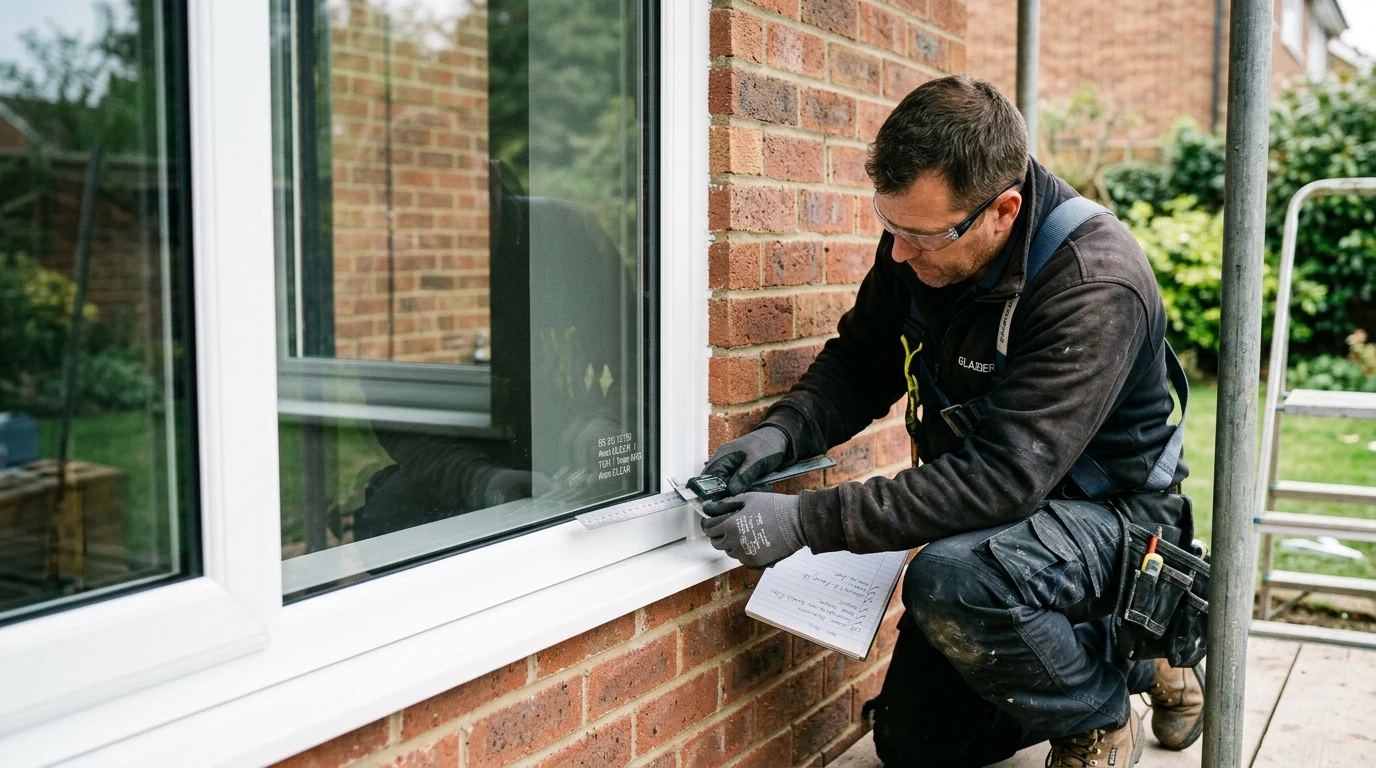
Every genuine Andersen insulated glass unit (IGU) features a permanent watermark laser-etched directly onto the glass surface. It is usually located in the bottom-right or upper-right corner as viewed from the inside of your home:
| Etched Marking Segment | Sample Value on Glass | Decoded Specification | Warranty & Service Utility |
|---|---|---|---|
| Andersen Logo | Triangle with “Andersen” lettering | Authentic OEM validation | Confirms coverage under Andersen’s 20-year limited glass warranty |
| Glass Performance Code | “Low-E4®” or “SmartSun™” | Thermal coating type | Establishes NFRC solar heat gain and U-factor ratings |
| Date Code (Month/Year) | “03/23” or “11/18” | March 2023 / November 2018 | Calculates exact remaining warranty time window |
| IGCC / SGCC Certification | “IGCC® CBA” or “SGCC® 1528” | Safety Glazing & Insulating Glass Council | Proves compliance with ASTM E2190 seal endurance standards |
| Plant / QMID Production Code | “BAY-2” or “LUR-4” | Bayport, MN or Luray, VA plant line | Allows technicians to retrieve original factory fabrication files |
How to Read Andersen Date Codes by Manufacturing Era
Andersen has evolved its logo and date-stamping protocol over more than a century of production. Use this chronological reference to identify your window’s generation:
| Manufacturing Period | Glass Etching Format | Balance & Hardware System | Warranty Status |
|---|---|---|---|
| Pre-1982 | Only the triangular Andersen logo; no date numerals | Cast metal balance boxes; non-tilt sash | Expired (Classic replacement parts available) |
| 1982 – 1998 | Andersen logo with two-digit year and month (e.g., “04 92”) | Tandem spring balances; early Perma-Shield vinyl cladding | Expired (Refurbishment hardware widely supported) |
| 1999 – 2007 | Introduction of “High-Performance” Low-E etching; date stamped on spacer bar | Modern concealed balances; early tilt-wash mechanisms | Expired (Glass warranty 20 years from install date) |
| 2008 – Present | “Low-E4®”, “SmartSun™”, or “HeatLock®” clearly etched with month/year | Easy-clean titanium dioxide exterior coating; modern sash locks | Active 20-Year Glass Warranty Coverage |
Spacer Bar Markings and Gas Fill Chemistry (Argon vs. Krypton)
In addition to the surface laser etching, Andersen insulated glass units incorporate diagnostic stamping along the interior perimeter spacer bar (the metal or composite channel separating the two panes of glass). When looking closely inside the perimeter seal, you will observe additional technical indicators:
- Gas Fill Designation: Units filled with inert thermal gas will be stamped “ARGON” or “AR/KR” (Argon/Krypton blend). Argon gas is six times denser than ambient air, dramatically slowing conductive heat transfer between the interior and exterior lites.
- Dual-Seal Polyisobutylene Barrier: Andersen utilizes a primary polyisobutylene (PIB) moisture vapor barrier backed by a structural silicone or polysulfide secondary seal. The spacer stamping reflects compliance with ASTM E2188 and E2190 gas retention specifications, ensuring gas leakage rates remain below 1% per decade.
- Desiccant Matrix: The hollow spacer bar is packed with molecular sieve desiccant beads designed to adsorb any residual atmospheric moisture trapped inside the cavity during factory assembly.
Andersen Glass Performance Packages: Low-E4 vs. SmartSun vs. HeatLock
Your glass etching confirms which energy-efficient glazing technology is installed in your home:
- Low-E4® Standard Glass: Outstanding all-around thermal performance. Outstanding winter heat retention and 84% blockage of damaging UV rays that fade hardwood floors and furniture.
- SmartSun™ Glass: Rejects 95% of thermal UV rays while maintaining crystal-clear visual clarity. Ideal for south-facing and west-facing exposures in sunny or hot climates.
- HeatLock® Coating: A microscopic, room-side coating applied to the interior pane that reflects escaping room heat back into the house, achieving triple-pane thermal U-factors in a slim double-pane footprint.
- PassiveSun® High-Solar-Gain Glass: Engineered specifically for extreme northern climates to maximize passive solar warmth during frigid winter months.
- Stormwatch® Impact Glass: Features heavy structural laminates designed to withstand 140+ mph hurricane projectile impacts along coastal building zones.
Genuine Andersen vs. Aftermarket Glass: Identifying Counterfeits
When purchasing a pre-owned home or hiring local glass repair contractors, homeowners are frequently unaware that failed glass was replaced with generic aftermarket sashes rather than authentic Andersen units:
| Inspection Checkpoint | Authentic Andersen OEM Sash | Generic Aftermarket Replacement Lite |
|---|---|---|
| Corner Glass Mark | Sharp, permanent laser watermark with trademark triangle | Generic glass temper stamp (e.g., “Guardian” or “PPG”) without logo |
| Spacer Bar Profile | Smooth stainless steel or composite warm-edge spacer with factory stamps | Crude aluminum box spacer with visible corner splice keys |
| Sash Fit & Weatherstrip | Exact factory compression seal; seamless slide in jamb liners | Loose fit, drafts, or binding during sash tilt-out operation |
| Manufacturer Warranty | Backed by Andersen 20-year transferable coverage | 1- to 5-year local contractor warranty; void for Andersen claims |
Filing a Warranty Claim for Fogged or Failed Glass
When an insulated glass unit suffers seal failure, moisture vapor enters the airspace between the panes, creating a permanent cloudy, milky, or iridescent rainbow haze that cannot be cleaned. Follow this simple 3-step warranty protocol:
- Photograph the Glass Etching: Take a high-resolution close-up photograph of the etched corner mark, ensuring the date code and Andersen logo are sharply focused.
- Photograph the Entire Window: Capture a wide shot of the whole window unit from the room interior, showing the sash and frame style (e.g., double-hung, casement, or awning).
- Submit Online or Call Andersen Warranty: Navigate to Andersen’s official warranty portal or contact an authorized service dealer. When prompted, provide the date code and QMID/Serial number. Under their 20-year non-prorated glass warranty, Andersen provides free factory replacement glass sashes for verified seal failures occurring within 20 years of manufacture.
Frequently Asked Questions
Where is the Andersen window serial number located?
The serial number is laser-etched in one of the corners of the glass pane, or printed on an adhesive white specification label affixed to the top head jamb inside the upper sash track.
What does QMID mean in Andersen ordering systems?
QMID stands for Quote Material Identification. It is the proprietary order line code that ties a specific custom window dimension, glass specification, and exterior color to the original customer quote in Andersen’s enterprise resource planning (ERP) database.
Can I replace just the glass or do I have to replace the whole window?
On virtually all Andersen 400 Series, 200 Series, and A-Series windows, you can replace just the glass sash without disturbing the exterior trim, interior casing, or master window frame, saving thousands of dollars compared to a full-frame replacement.
How do I know if my Andersen window qualifies for federal tax credits?
Check the glass etching for Low-E4 or SmartSun markings. To qualify for the Section 25C Energy Efficient Home Improvement Credit, the window must meet regional Energy Star Most Efficient criteria (U-factor ≤ 0.20 in Northern zones). You can download the official Manufacturer’s Certification Statement directly from Andersen using your product code.
Why does condensation appear between the glass panes of my Andersen window?
Internal condensation between glass panes is the hallmark sign of perimeter seal failure. Atmospheric air containing humidity has penetrated the secondary seal and overwhelmed the desiccant matrix, requiring sash replacement under warranty.
Get our latest guides, news, and insights highlighted in your Google Search & AI Overviews.