
✨ This article was AI edited. Editorial responsibility: WindPowerFacts.info.
Produced with AI. This article was artificially generated. Editorial responsibility: WindPowerFacts.info.
What is green energy wind and how does it work? Green energy wind refers to electricity generated by capturing the kinetic motion of atmospheric air currents with aerodynamic turbine blades, which drive an electrical generator without burning fossil fuels or releasing direct greenhouse gas emissions. Generating electricity with a lifecycle carbon footprint of just 11 to 12 grams of CO&sub2 equivalent per kilowatt-hour (gCO&sub2eq/kWh), wind power is recognized as one of the cleanest, lowest-cost renewable energy sources on Earth.
As international economies seek to decarbonize power grids and replace depleting hydrocarbon reserves, wind power has surged to the forefront of the global energy transition. Modern multi-megawatt turbines represent marvels of mechanical, aerodynamic, and electrical engineering. Understanding how green wind energy functions—from aerodynamic lift on composite rotor blades to high-voltage grid dispatch—is essential for comprehending the renewable infrastructure powering our 21st-century electrified economy.
The Physics of Wind Generation: From Kinetic Motion to Grid Power
Generating electricity from wind is an exercise in applied fluid dynamics and electromagnetic induction. The operational sequence unfolds in five sequential stages:
- Atmospheric Pressure Gradients: The sun unevenly heats the Earth’s surface and atmosphere. Warm equatorial air rises while colder polar air sinks, creating atmospheric pressure differentials that drive continuous global wind patterns.
- Aerodynamic Lift: As air flows across the curved airfoil cross-section of a turbine blade, it moves faster over the curved upper surface than the flat lower surface. According to Bernoulli’s principle, this creates a localized pressure differential, generating aerodynamic lift rather than simple drag, which forces the rotor to spin.
- Torque Amplification: On geared turbines, the massive low-speed main shaft (rotating at 8 to 16 RPM) turns a planetary gearbox that accelerates mechanical rotational speed to 1,200 to 1,800 RPM. On direct-drive turbines, the rotor connects directly to a low-speed, permanent-magnet synchronous generator.
- Electromagnetic Induction: The spinning rotor turns powerful magnetic fields across copper stator windings, producing medium-voltage alternating current (AC) electricity (typically 690 volts).
- Power Conditioning and Transmission: Full-scale frequency converters condition the power to match grid voltage and phase synchronization. A pad-mount transformer at the tower base steps the voltage up to 34.5 kilovolts for collection, which a regional substation further elevates to 115–500 kV for long-distance transmission lines.
Green Energy Comparison: Lifecycle Emissions and Environmental Metrics
A rigorous metric for evaluating the “green” credentials of any energy source is its total lifecycle environmental footprint, which includes raw material mining, manufacturing, transportation, 25-year operation, and end-of-life decommissioning:
| Energy Generation Technology | Lifecycle Carbon Intensity (gCO&sub2eq/kWh) | Operational Water Consumption (L/MWh) | Levelized Cost of Energy (LCOE $/MWh) | Energy Payback Time (Months) |
|---|---|---|---|---|
| Onshore Wind Power | 11 – 12 | 0 | $28 – $45 | 5 – 7 months |
| Offshore Wind Power | 12 – 14 | 0 | $65 – $95 | 6 – 9 months |
| Utility-Scale Solar PV | 35 – 45 | 0 (minimal washing) | $32 – $50 | 12 – 18 months |
| Nuclear Energy | 12 – 16 | 2,500 – 3,500 | $130 – $180 | N/A (Capital intensive) |
| Natural Gas (Combined Cycle) | 450 – 520 | 700 – 1,100 | $45 – $75 | Continuous emissions |
| Supercritical Coal | 820 – 1,050 | 1,500 – 2,200 | $75 – $150 | Continuous emissions |
Key Takeaway: A modern wind turbine produces enough clean electricity within its first 6 months of operation to completely offset all the energy and carbon emissions consumed during its manufacturing, transportation, and installation.
Onshore vs. Offshore Wind: Two Frontiers of Green Power
Green wind technology has diverged into two complementary utility sectors:
1. Onshore Wind Turbines
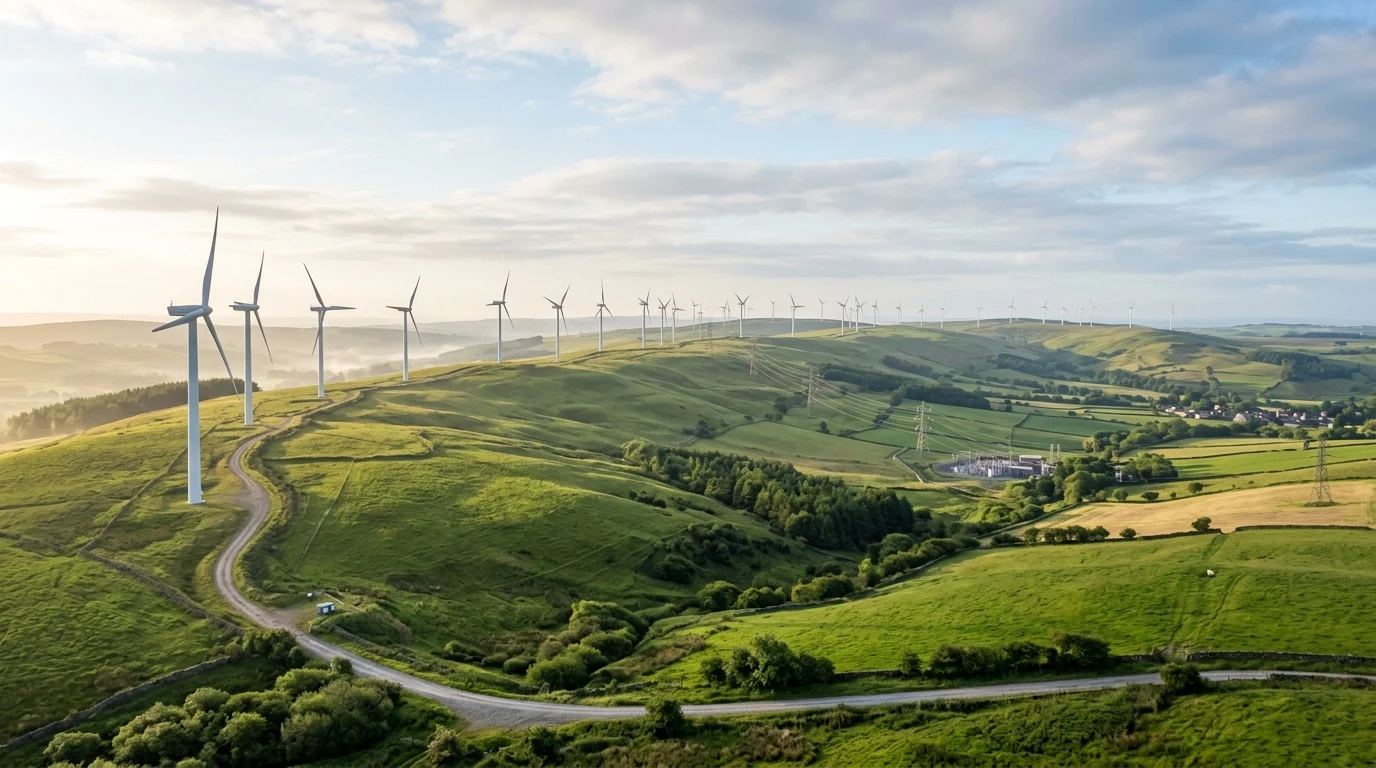
Onshore wind represents the workhorse of current renewable capacity. Installed in agricultural wind corridors (such as the American Great Plains, Spanish mesetas, or Northern European plains), onshore projects feature lower capital costs, straightforward grid interconnects, and standard highway crane installation. Modern onshore towers stand 80 to 120 meters tall with rotor diameters spanning 110 to 160 meters, generating 2 to 6 megawatts per unit.
2. Offshore Wind Turbines
Marine winds over open oceans blow faster, smoother, and far more consistently than terrestrial winds due to zero topographical surface friction. Offshore turbines have reached colossal dimensions: commercial giants like the Vestas V236-15.0 MW and GE Haliade-X 14 MW feature rotor diameters exceeding 220 to 236 meters—sweeping an area greater than four standard football pitches per turbine. Offshore capacity factors frequently surpass 50% to 60%, delivering baseload-like reliability to major coastal metropolitan centers.
Overcoming Intermittency: Modern Grid Integration and Storage
The primary engineering challenge of wind energy is variability: the wind does not blow at the exact same velocity 24 hours a day. Grid operators deploy four proven technical solutions to balance supply with demand:
- Geographic Diversity: Linking regional wind farms across high-voltage direct current (HVDC) transmission corridors ensures that when wind subsides in one state or province, high winds in neighboring regions supply the deficit.
- Solar and Wind Hybrid Integration: Solar PV peaks during midday hours, while atmospheric wind currents typically intensify during late afternoons, evenings, and overnight, providing a complementary diurnal generation curve.
- Grid-Scale Battery Storage (BESS): Multi-hundred-megawatt lithium-iron-phosphate (LFP) battery complexes store excess generation during windy, low-demand nights and discharge power during morning peak demand.
- Green Hydrogen Production: Surplus off-peak wind electricity powers industrial electrolyzers to split water into green hydrogen, providing zero-carbon fuel for long-haul transport, maritime shipping, and green steel manufacturing.
Frequently Asked Questions
Can wind turbine blades be recycled?
Historically, thermoset composite blades were difficult to process, with spent blades consigned to specialized concrete filler or industrial shredding. Today, manufacturers have deployed thermoplastic recyclable resins (such as Siemens Gamesa’s RecyclableBlade and Vestas circular epoxy technology) that enable 100% blade recovery, while over 85% of total turbine mass (steel tower, copper, cast iron) is already fully recyclable.
How long do modern wind turbines last?
Commercial wind turbines are certified for a design life of 25 to 30 years. Routine preventative maintenance (oil filtration, bearing grease, leading edge blade repairs) ensures high operational availability throughout this lifespan, after which sites can be repowered with newer, more powerful generators.
Does wind power work in cold winter weather?
Yes. Turbines deployed in cold-climate regions (such as Canada, Scandinavia, and the Northern Plains) feature specialized cold-weather packages, including synthetic low-temperature lubricants, heated nacelles, and electro-thermal de-icing heating elements embedded within the composite blade shells.
How much electricity does a single wind turbine produce in a day?
A typical 3-megawatt onshore turbine operating at an average 35% capacity factor produces approximately 25,000 to 30,000 kilowatt-hours (kWh) of electricity per day—enough to power between 800 and 1,000 average American single-family homes.
Get our latest guides, news, and insights highlighted in your Google Search & AI Overviews.