
✨ This article was AI edited. Editorial responsibility: WindPowerFacts.info.
Produced with AI. This article was artificially generated. Editorial responsibility: WindPowerFacts.info.
What is a windmill maintenance salary? Windmill and wind turbine maintenance professionals earn an average annual salary of $62,500 ($30.05/hour) in the United States. Entry-level maintenance technicians start around $47,000, while lead mechanical specialists, traveling diagnostic technicians, and offshore supervisors command salaries ranging from $82,000 to over $118,000 annually with overtime and per diem allowances.
The term “windmill maintenance” historically referred to mechanical pump mills used for agricultural livestock watering and grain milling. In modern industrial terminology, the phrase is widely used to describe the operations and maintenance (O&M) of utility-scale multi-megawatt wind turbines as well as commercial distributed wind generators. Regardless of whether servicing legacy agricultural wind engines or modern 5-megawatt direct-drive turbines, mechanical maintenance technicians occupy a vital, high-earning position within the energy sector.
Windmill Maintenance Salary and Total Compensation Breakdown
Salaries for windmill maintenance personnel vary significantly across job roles, mechanical specializations, and operational environments:
| Maintenance Specialization | Primary Mechanical Duties | Starting Salary (Base) | Mid-Career Salary (Base) | Senior / Lead Total Compensation |
|---|---|---|---|---|
| Utility Wind Turbine Tech | Gearbox lubrication, yaw alignment, sensor swaps | $48,000 – $56,000 | $62,000 – $75,000 | $90,000 – $115,000+ |
| Traveling O&M Field Tech | Emergency fault repair, scheduled campaign overhauls | $55,000 – $65,000 | $72,000 – $88,000 | $105,000 – $130,000+ |
| Blade Composite Repair Specialist | Fiberglass laminating, leading edge erosion fix, rope access | $52,000 – $62,000 | $70,000 – $85,000 | $98,000 – $125,000 |
| Agricultural Wind Pump Tech | Aermotor 702 maintenance, pump cylinder packings, well rods | $42,000 – $48,000 | $52,000 – $64,000 | $70,000 – $85,000 |
| Offshore Wind Maintenance Specialist | Subsea cable monitoring, marine nacelle maintenance | $70,000 – $82,000 | $88,000 – $110,000 | $125,000 – $160,000+ |
Key Factors Influencing Windmill Maintenance Earnings
Technicians looking to maximize their annual maintenance salary can leverage several distinct high-value credentials and working arrangements:
1. High-Angle Rope Access (SPRAT / IRATA)
Working suspended from ropes outside the turbine tower or nacelle requires rigorous certification. Certified rope technicians who perform ultrasonic non-destructive testing (NDT) and structural composite repairs command premium contract rates, earning $5 to $12 per hour above standard ground-based maintenance personnel.
2. OEM Factory Certifications
Turbine manufacturers such as Vestas, Siemens Gamesa, and GE Vernova maintain proprietary control systems and mechanical architectures. Technicians holding certified OEM diagnostic credentials (such as GE 1.5/2.X or Vestas V110/V136 qualified technician status) consistently command higher starting salaries and preferential placement on major repowering projects.
3. Travel Per Diem and Overtime Multipliers
Wind energy generation peaks during seasonal meteorological shifts in the spring and autumn. During these bi-annual maintenance campaigns, technicians routinely work 50 to 60 hours per week. Because time-and-a-half overtime is mandatory after 40 hours under federal labor standards, an industrious technician with a $30/hour base wage can easily net an additional $20,000 to $30,000 in overtime pay alone, complemented by untaxed federal daily per diem payments ($140–$200/day).
Daily Maintenance Responsibilities: What the Job Entails
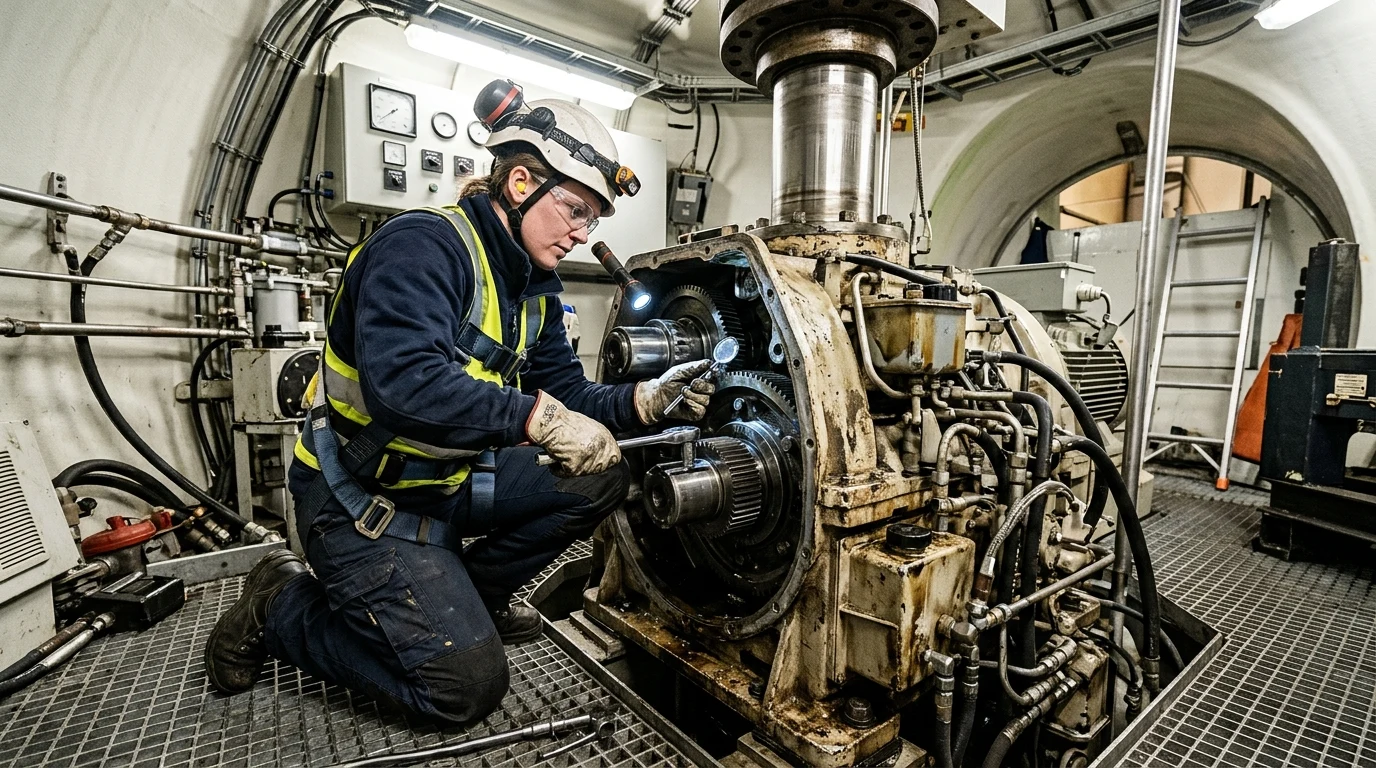
Unlike factory mechanics who work in temperature-controlled facilities, windmill maintenance technicians must perform demanding physical labor in extreme environments:
- Routine Fluid Servicing: Draining, flushing, and replacing hundreds of gallons of synthetic gearbox lubricant, hydraulic pitch fluids, and main bearing grease.
- Torque and Tension Audits: Utilizing calibrated hydraulic torque wrenches to verify thousands of structural bolts across the foundation, tower flange rings, and blade pitch bearings.
- Vibration Analysis and Condition Monitoring: Installing accelerometers to detect early subsurface micro-pitting in gearbox planetary stages before catastrophic mechanical failure occurs.
- Electrical and PLC Diagnostics: Troubleshooting 690-volt generator circuits, variable frequency converters (VFDs), fiber optic communication lines, and automated pitch batteries.
- Agricultural Windmill Overhaul: For rural water-pumping windmills, inspecting oil reservoirs, replacing babbitt bearings, renewing pitman arms, and adjusting tail vane spring governors.
Regional Salary Comparison Across Major Wind Producing States
| State | Average Annual Base Salary | Average Hourly Wage | Local Wind Industry Profile |
|---|---|---|---|
| Texas | $64,850 | $31.18 / hr | Highest total wind turbine capacity in North America |
| Iowa | $62,110 | $29.86 / hr | Over 60% of state electricity generated by wind |
| California | $74,220 | $35.68 / hr | High state prevailing wage requirements and union representation |
| Kansas | $61,500 | $29.57 / hr | High-capacity wind belt with vast utility wind farms |
| Colorado | $68,900 | $33.12 / hr | Regional corporate headquarters and technical training academies |
Frequently Asked Questions
How long does it take to become a certified windmill maintenance technician?
Most vocational certificate programs take 6 months to 1 year to complete. Associate of Applied Science (AAS) degrees in Wind Energy Technology take 2 years. Many employers also hire automotive or electrical apprentices directly and provide paid factory training.
Is windmill maintenance a dangerous profession?
Working at height and handling high voltage entails inherent risks, but the wind industry enforces strict OSHA and GWO safety protocols. All technicians utilize 100% tie-off fall arrest lanyards, climb-assist systems, arc-flash PPE, and emergency nacelle descent rescue devices.
Do windmill technicians receive health insurance and retirement benefits?
Yes. Major wind energy operators, independent service providers, and utility companies provide comprehensive benefits, including medical, dental, vision, life insurance, paid time off, and 401(k) plans with employer matching (typically 4% to 6%).
What is the physical retirement age for wind technicians?
Because daily climbing is physically intensive, many technicians transition into site manager, safety coordinator, remote operations center (ROC) controller, or technical trainer positions in their 40s and 50s, continuing to earn top-tier salaries without daily ladder climbs.
Get our latest guides, news, and insights highlighted in your Google Search & AI Overviews.